Klaviyo alternatives: where to go at 5,000 and 10,000 contacts
By Mara Levin · Updated October 7, 2026 · Vendor pages and prices checked that day
Klaviyo is a customer-data and messaging platform that is priced by the number of active profiles you hold, and that is the main reason people look elsewhere: the bill moves with list size, and the paid figure sits behind an estimator rather than a printed table. This page puts five alternatives side by side at two list sizes, and covers the cheaper move for people who only dislike its email editor.
The short answer
An online store that wants to stay close to its shop data should look at Drip or Omnisend. A newsletter or a content business gets the most for the least on MailerLite. A software product that emails users from its own events should compare Customer.io and Loops. If the editor alone is the complaint, import HTML from a builder and stay.
What Klaviyo charges, in two sentences
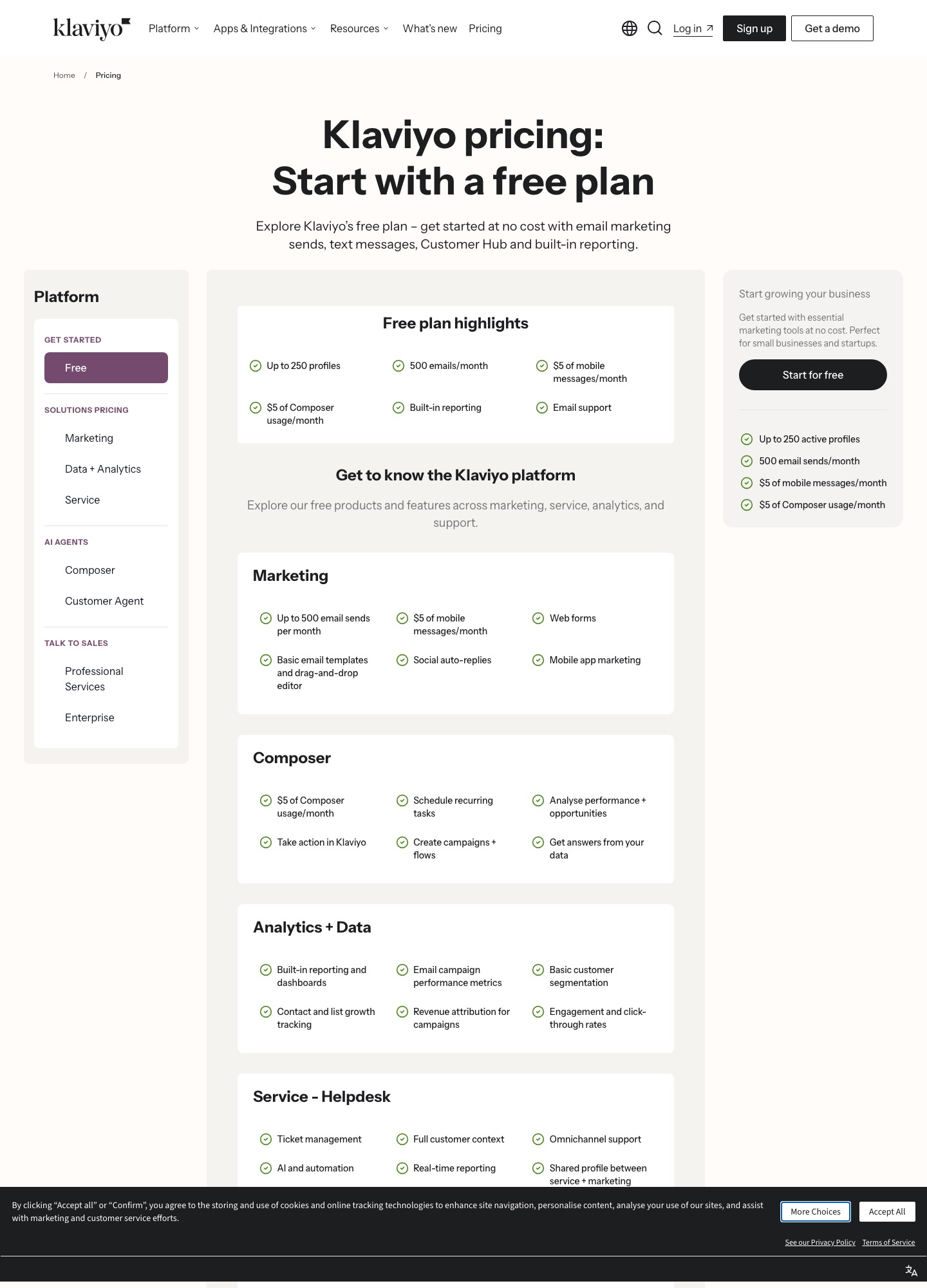
Klaviyo's pricing page offers a free plan of up to 250 active profiles and 500 emails a month, then paid plans that scale with profile count through a plan estimator. Because the paid figure comes out of an estimator keyed to your own profile count, this page states no paid Klaviyo number; look yours up on that page before comparing.
Why teams leave
- The unit is the active profile. Klaviyo's page describes limits in terms of "active profiles" and monthly sends. When your list grows, both counters grow, and the plan estimator is the only place the number appears.
- The free plan stops sending. Past 250 profiles or 500 sends, the page says the account cannot send more until the next cycle or an upgrade. There is no pay-as-you-go overage described.
- Support thins out on the free plan. The page says email support applies for the first 60 days, after which free users rely on the Help Center, Academy and community.
- More than email. The free plan bundles mobile messaging credit, an AI assistant called Composer and a customer-service helpdesk. If you want only email, you are paying a platform price for one channel.
- Ecommerce first. The product is built around shop data, so a B2B or content site gets less out of its core strength than a store does.
The alternatives, priced at two list sizes
| Tool | Billed by | About 5,000 | About 10,000 |
|---|---|---|---|
| Mailchimp Standard | Contacts | $100 (2,501 to 5,000) | $135 (5,001 to 10,000) |
| MailerLite Comfort / Power | Subscribers | $49 / $69 | $89 / $129 |
| Drip | Active people and sends | $89 | $154 |
| Customer.io Essentials | Profiles | $100 (5,000 profiles) | $145 (10,000 profiles) |
| Loops | Subscribers | $48 at 4,788 | $99 at 9,998 |
| Klaviyo | Active profiles and sends | Look up in its estimator; free up to 250 profiles | |
Prices are monthly list prices from Mailchimp, MailerLite (monthly billing), Drip, Customer.io and Loops. Mailchimp's page shows a 50% promotion for the first 12 months that I leave out. The figures count different things, so never compare one row to another without reading what the row measures.
Who should switch to what
A shop with product and order data. Staying close to commerce events matters more than price here. Drip's page prices by active people and sends, with 600,000 sends included at 50,000 people, and ActiveCampaign vs Drip compares it with a CRM-led rival. Omnisend lists a free plan of 250 contacts and 500 emails, then Standard at $11.20 and Pro at $41.30 a month on promotional pricing, and bills for subscribers and non-subscribers who received automated messages.
A creator or a small publisher. MailerLite has a free plan with up to 250 subscribers and 2,500 monthly emails, Comfort from $12 a month at 500 subscribers and Power from $25. It is the plain, cheap answer for a list that mostly receives newsletters.
A software product that emails its users. Customer.io Essentials starts at $100 a month for 5,000 profiles and $145 for 10,000, while Loops charges $99 at about 10,000 subscribers and has a free tier. Customer.io vs Loops works through the choice, and Customer.io vs Drip covers events against store data.
A business that wants lots of integrations and a familiar editor. Mailchimp lists 300+ integrations, with Standard at $20 for the first 500 contacts. See Mailchimp alternatives for its own caveats.
The option nobody lists: keep Klaviyo, change the editor
If the template editor is the only thing wearing you out, you do not need a new platform. Klaviyo's help center says custom HTML templates are imported from an .html file (it must contain an unsubscribe tag), that you can upload a zip of images, and that hybrid templates let you add drag-and-drop blocks to custom HTML through one code snippet. Postcards' page lists Klaviyo among its export targets, and Beefree's FAQ says clean HTML export reaches Klaviyo. A builder at $10 (Topol PRO) to $20 (Stripo Basic) a month gives you a different design environment while profiles, flows and revenue reports stay where they are. See Beefree alternatives and Stripo alternatives.
What to save before you leave
- Profiles with consent status. Export subscribed, unsubscribed and suppressed profiles separately so no one who opted out is mailed again.
- Template HTML. Klaviyo's import article mentions exporting a template built in its drag-and-drop editor, so an export exists, but warns that importing such an export back is not recommended. Treat exports as a reading copy and keep your own source files.
- Flow diagrams. Flows do not travel between platforms. Screenshot each one, list triggers, delays, splits and filters, and rebuild them by hand.
- Segment definitions. Write out the rules (for example, bought in the last 60 days and not opened in 30) so you can recreate them where the new tool's fields differ.
- Revenue and engagement reports. The free plan lists revenue attribution for campaigns, and that history will not follow you. Export it for your records.
- SMS and push. If you use Klaviyo's mobile messaging, check that the new vendor sends it. Omnisend lists SMS from $0.007 per message; Mailchimp offers SMS as an add-on to paid plans in select countries.
How the move goes
Start with the welcome flow and the post-purchase flow, since they produce the most revenue per email, and run them in the new tool for two weeks while the old ones keep sending. Warm the sending domain gradually, authenticate it with SPF and DKIM, and move the list in two or three waves. Turn off each Klaviyo flow only after its replacement has delivered a full cycle, and downgrade to the free plan last, so history stays readable while you finish.
Stay if…
- Your store's data feeds segments and flows that no cheaper tool on this list can recreate.
- The estimator figure for your profile count is lower than the alternatives in the table above.
- The editor is the only problem, and importing HTML or hybrid templates solves it.
FAQ
How much does Klaviyo cost?
Its pricing page leads with a free plan: up to 250 active profiles, 500 email sends a month, $5 of mobile messages and $5 of Composer usage. Paid email prices depend on your active profile count and sends, and the page presents them through a plan estimate rather than a fixed table, so I list no paid figure here. Open the estimator with your own profile count, and check the breakdown before comparing.
What happens when I pass the free limits?
The page's FAQ says your account will no longer be able to send additional emails or messages until the next billing cycle, or until you upgrade. For a store with a promotion running, that is a hard stop in the middle of a campaign, so the free plan suits testing more than a live program.
Can I use Klaviyo with a template built elsewhere?
Yes. Klaviyo's help center describes importing a custom HTML template from an .html file, and the template must include an unsubscribe tag. It also supports hybrid templates, which are custom HTML with drag-and-drop blocks added through one code snippet. Templates from other platforms may contain tags Klaviyo does not support, so remove them and use Klaviyo's double-brace variables.
What is the cheapest alternative at 5,000 contacts?
On the pricing pages read for this guide, Loops lists $48 at 4,788 subscribers. MailerLite Comfort is $49 at 5,000, Drip $89, Customer.io Essentials $100 at 5,000 profiles and Mailchimp Standard $100 for 2,501 to 5,000 contacts. They do different jobs, so the cheapest is only the right one if it has the integrations your shop or product needs.