Mailchimp alternatives: who is better off elsewhere, and when the move is worth it
By Mara Levin · Updated October 7, 2026 · Vendor pages and prices checked that day
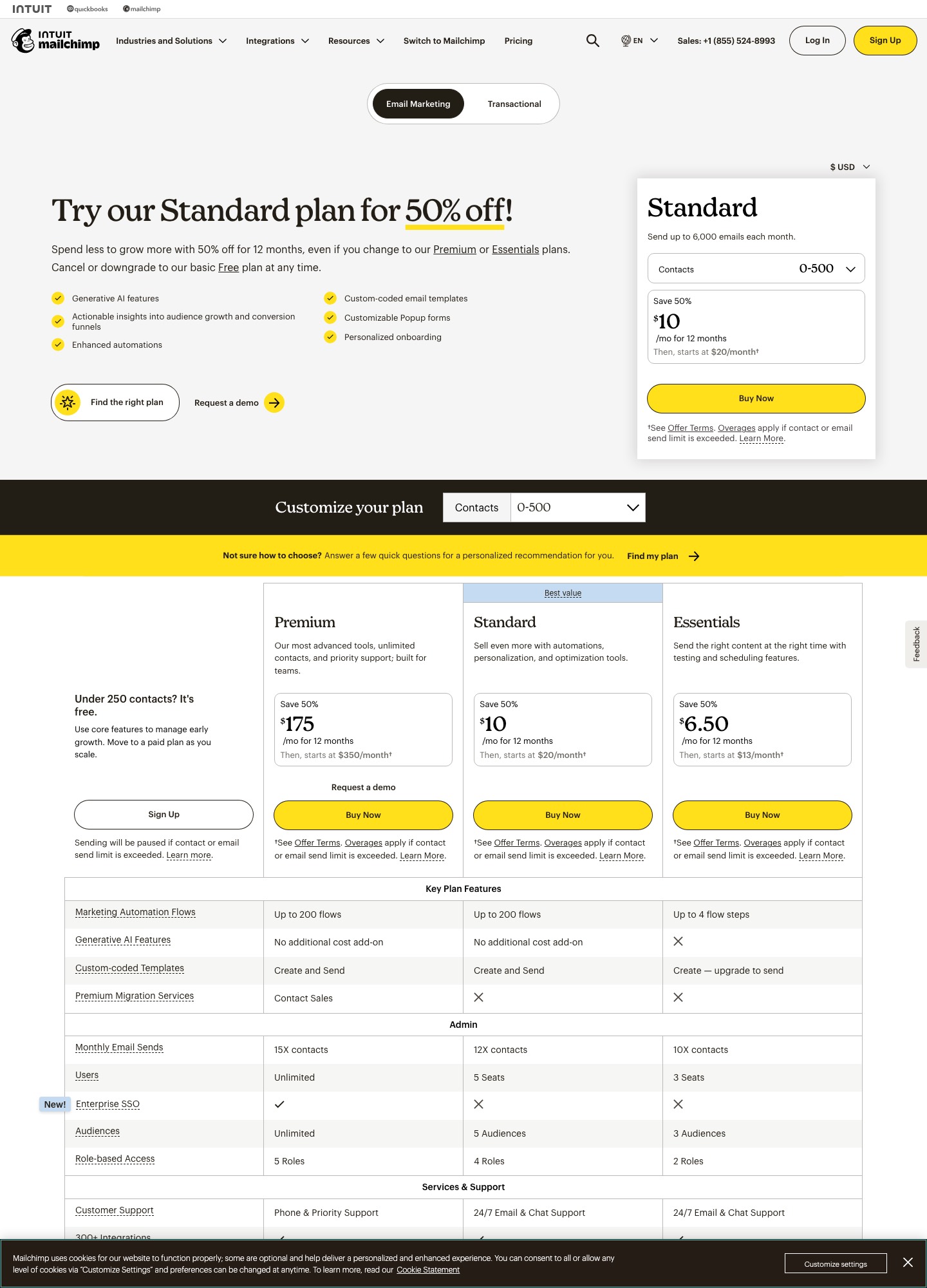
Mailchimp is the default newsletter and campaign platform, with 300+ integrations and a builder that sends custom-coded templates from its Standard plan. People look for another one when the bill steps up with list size, or when the 50% first-year offer on its pricing page runs out. This page shows what Mailchimp costs at 500, 5,000 and 10,000 contacts, who should move to what, and what the move involves.
The short answer
If your list is mostly newsletter readers, MailerLite and EmailOctopus cost much less than Mailchimp once you pass 2,500 contacts. If automation is the reason you pay, price ActiveCampaign at your list size and expect it to be close, not cheaper, at 10,000. If you sit at a few hundred contacts on a small plan, Mailchimp is fine and moving saves little. And if you dislike only the editor, you can design in a separate builder and send from Mailchimp.
What Mailchimp charges, in two sentences
Mailchimp's pricing page lists a Free plan, then Essentials from $13, Standard from $20 and Premium from $350 a month at 0 to 500 contacts, each rising with the contact band you select. A 50% introductory offer for the first 12 months is shown on the same page, and the full band-by-band table lives there.
Why people leave
- The price steps are steep. Standard is $20 at 0 to 500 contacts, $100 at 2,501 to 5,000, $135 at 5,001 to 10,000 and $230 at 10,001 to 15,000. A list ten times bigger costs five times more at the 5,000 mark.
- The introductory offer ends. At 2,501 to 5,000 contacts the page shows $50 a month for 12 months, then $100. Your second year costs double for an identical list.
- Duplicates are billed. The plan table notes that a contact added to more than one audience counts as many times as they appear, so a messy account pays for the same person twice.
- Essentials is a trimmed plan. It allows flows of up to 4 steps and three seats, and custom-coded templates can be created but not sent until you upgrade. Standard raises that to 200 steps per flow and five seats.
- The free plan pauses. The page says sending is paused when the contact or send limit is exceeded, not billed as an overage as on paid plans.
- A large list is a conversation. Above 200,000 contacts the FAQ points to a high-volume plan and "Contact us for pricing".
What it costs against the alternatives
| Tool | Billed by | 5,000 contacts | 10,000 contacts |
|---|---|---|---|
| Mailchimp Standard | Contacts | $100 | $135 |
| MailerLite Comfort / Power | Subscribers | $49 / $69 | $89 / $129 |
| ActiveCampaign Starter / Plus | Contacts, annual billing | $79 / $145 | $149 / $189 |
| Brevo Starter / Standard | Emails sent | From $9 / from $18 a month, set by the email volume you select | |
| EmailOctopus Pro | Subscribers and emails | $9 a month billed yearly at the entry band; free up to 2,500 subscribers | |
| Mailjet | Emails sent | Free 6,000 a month; Starter $9, Essential $19, Premium $29 for 15,000 on the last two | |
Prices come from MailerLite (monthly billing), ActiveCampaign, Brevo, EmailOctopus and Mailjet. Mailchimp's own numbers exclude the first-year offer. Notice that ActiveCampaign Starter at 10,000 contacts, $149, is above Mailchimp Standard's $135: automation depth is its reason to exist, not a cheaper list.
Who should switch to what
A newsletter with a few thousand readers. MailerLite's free plan allows up to 250 subscribers and 2,500 emails a month, and Comfort at $49 for 5,000 subscribers is roughly half of Mailchimp's $100. EmailOctopus has the larger free tier, 2,500 subscribers and 10,000 emails, with its own branding on messages. See EmailOctopus alternatives for the other direction.
A team whose emails are triggered by behaviour. ActiveCampaign Starter is $15 at its entry band and Plus is $49, billed annually. Mailchimp's Standard allows up to 200 steps per flow, so a team using multi-branch journeys should compare flows, not only prices. For the SaaS version of that question, ActiveCampaign vs Drip is the closer read.
A store. The Mailchimp fit weakens when your data is orders and products. Klaviyo alternatives prices the shop-specific options side by side.
Someone sending a modest, steady volume. Brevo bills by emails rather than contacts, with a free plan of 300 emails a day and Starter from $9. That model can favor a large list that gets few emails, so read its volume selector against your actual sends before ruling it in or out.
A designer who likes Mailchimp's sending but not its editor. Stay, and read Mailchimp vs Beefree.
The option nobody lists: keep the sender, change the editor
Mailchimp's plan table lists custom-coded templates as "Create and Send" on Standard and Premium, and "Create — upgrade to send" on Essentials. So on Standard you can build a template in any tool, paste the HTML in, and send it from Mailchimp. Postcards' pricing page names Mailchimp as a direct export target, and builders such as Beefree and Stripo list it too. A builder at $10 to $30 a month costs far less than moving a list and rebuilding automations, which suits teams whose complaint is design speed, not sending.
What to save before you leave
- Audiences, deduplicated. Export each audience with subscription status, source and date, then merge people who sit in more than one so you neither pay twice nor import twice.
- Unsubscribed and cleaned contacts. Carry them over as a suppression list. Importing them as active would breach the consent they withdrew.
- Templates. Keep the HTML of every campaign and automation template, plus the image files they reference.
- Automation maps. Document each flow's trigger, delay, branch and exit rule on paper. Flows do not move between tools, and Essentials flows with 4 steps are easy, while 200-step Standard flows take planning.
- Tags, groups and segments. Note the definitions, since each platform names and stores them differently.
- Reports. Export campaign statistics you may need for a client or an audit, because the history stays with Mailchimp.
How the move goes
Authenticate your domain at the new platform with SPF and DKIM before sending anything. Import the cleaned list and run one ordinary campaign to a small engaged segment, then the full list. Rebuild automations in order of revenue, running old and new in parallel until the new one has completed a cycle. Pay for one more Mailchimp month at the lowest plan that keeps your data readable, then downgrade or close the account.
Stay if…
- You are under 500 contacts on Essentials or Standard, where $13 or $20 is cheap and the integrations matter.
- Your team relies on Mailchimp's 300+ integrations, roles and seats.
- The introductory offer is still running and your list is small enough that a move costs more in time than it saves.
FAQ
Does Mailchimp still have a free plan?
Yes: up to 250 contacts and 500 sends a month with a cap of 250 a day, one seat and email support for the first 30 days. Its pricing page says sending will be paused if the contact or email limit is exceeded, which differs from paid plans, where overages are billed instead. For a bigger free list, EmailOctopus lists 2,500 subscribers and 10,000 emails a month.
Why did my Mailchimp bill double after a year?
The pricing page advertises 50% off for 12 months. At the 2,501 to 5,000 contacts band it reads $50 a month for 12 months and then starts at $100 a month. If you signed up on that offer, the second year costs twice the first for the same list, which is the moment many people compare other tools.
Do contacts in two audiences count twice?
According to Mailchimp's plan table, adding a contact to more than one audience counts them toward your plan's contact total as many times as they appear. Merge duplicate audiences before you judge what you owe, and before you import your list anywhere else, because the same person will otherwise arrive twice.
What is the cheapest alternative at 5,000 contacts?
MailerLite Comfort lists $49 a month at 5,000 subscribers, against Mailchimp Standard at $100 for the 2,501 to 5,000 band, and ActiveCampaign Starter at $79 on annual billing. Brevo prices by email volume instead, with Starter from $9 a month. The comparison changes if you need advanced automation or a specific integration, so check both before moving.